
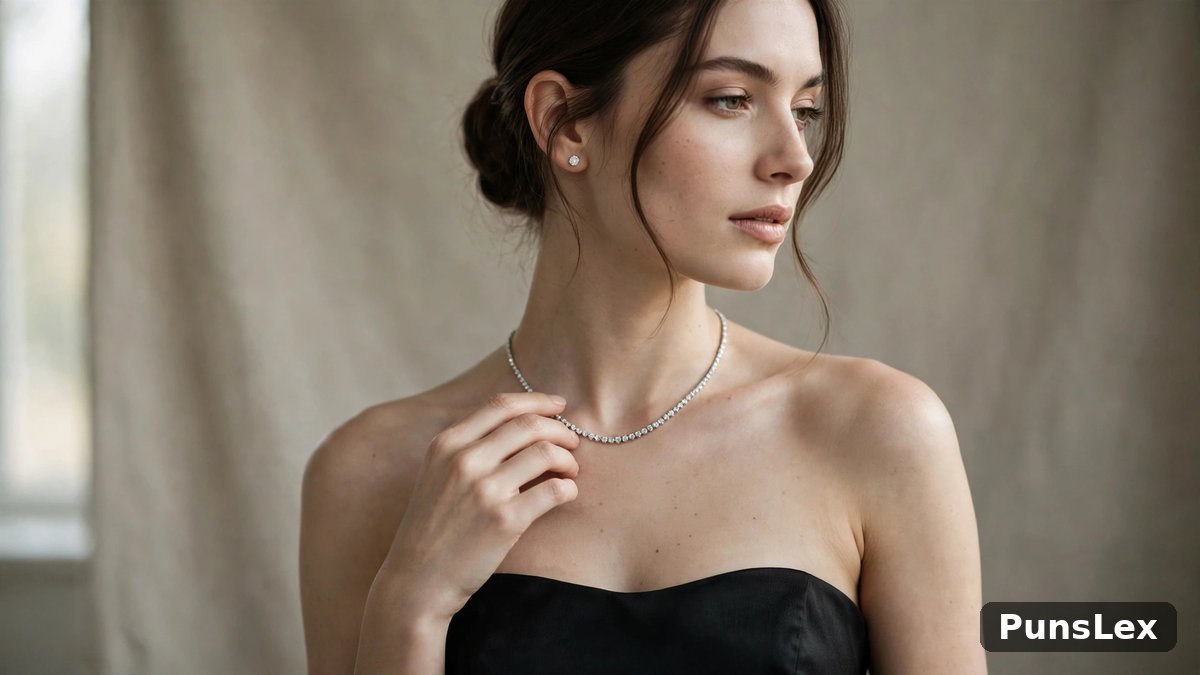
Earrings or Necklace? The Quiet Rules of Wearing Serious Diamonds
Every jewellery stand-off I have ever witnessed happened in front of a mirror, minutes before the taxi arrived: beautiful earrings in one hand, a beloved necklace in the other. The diamond earrings vs necklace styling rules below are the ones I give clients who buy their own pieces and intend to wear them for decades.
The short version is one sentence long: choose a single focal point, then let everything else support it quietly. Diamonds compete with each other faster than any other stones, because every facet is asking for the same light. Two loud pieces do not double the effect. They halve it.
What follows is the working logic: how necklines vote, how face shape breaks ties, why light outranks carat weight, and when the honest answer is to wear one piece and leave the other in its box. None of it requires a stylist on retainer. It requires ten calm minutes before you get dressed.
Decide your focal point before you get dressed
Pick the lead piece first and build the outfit around it, not the other way round. If the earrings are doing the talking — drops, clusters, anything with movement — the neck stays quiet or bare. If a diamond line sits at the collarbone, earrings become punctuation: small studs, a tight cluster, nothing that swings.
The exception is the deliberate matched set, and it is a demanding one. Full sets can look magnificent, but they need a plain, structured outfit to sit against: black crepe, ivory silk, a clean shoulder line. Add pattern, texture or a busy neckline and the same set tips from polished into costume.
Scale the decision to your frame as well. A petite build is easily outnumbered by a wide line necklace and long drops worn together, while a taller frame can carry one generous piece without effort. The rule I repeat most: one statement per outfit. Everything after the first statement is supporting cast.
A simple test
Before you commit, run the mirror test stylists use backstage. It takes thirty seconds and settles most arguments.
- Stand at conversational distance, roughly two metres back, and note where your eye lands first. If it bounces between ears and neck, one piece comes off.
- Turn your head slowly side to side. Jewellery that only works head-on will disappear the moment you start talking.
- Sit down. Necklines shift when you sit, and a pendant that behaved standing may pool or swing at the table.
- Check the combination in the light you will actually be in — hallway or window light, not the bathroom’s brightest bulb.
Read the neckline, not the dress
Necklines dictate necklaces far more than colour or fabric ever will. A crew neck or turtleneck leaves no useful space at the throat, so earrings win by default — this is the natural home of a bolder drop. The one exception is a long pendant worn over the fabric, which reads as part of the outfit.
A V-neck invites length: a solitaire pendant resting just above the point of the V, or a fine chain following the V’s own lines. A scoop neck wants the opposite — a rounded pendant echoing its arc. Chain length is where most people guess, so measure once against a necklace length and neckline chart and end the guesswork.
Open and strapless necklines are the most forgiving, which is why diamond lines look so natural with them: a continuous row follows the collarbone and reads as part of the body. Off-the-shoulder styles are trickier, because the bare shoulder already draws a diagonal — keep the necklace short and close. With a halter, skip the necklace entirely.
Layering without clutter
If you layer, give each chain its own territory. A gap of a few centimetres between pieces stops them tangling, overlapping and photographing as one muddled mass. Vary the visual weight as well: a fine solitaire pendant above a denser line of stones reads as deliberate, while two pieces of similar scale look like indecision.
Two more working rules. Stop at two layers unless the third is barely there — three chains is a look, four is a drawer emptied onto your neck. And mix chain types, not just lengths: a fine cable chain beside a slightly heavier link chain stays separated, while identical chains braid themselves together by dessert.
Let your face shape cast the deciding vote
When earrings and necklace genuinely tie, let your face break the deadlock. Earrings sit in the frame of the face itself, so their shape argues with — or flatters — your bone structure all evening. Necklaces can be adjusted by an inch. Earrings either suit your face or they do not.
A round face gains length from drops and dangles, which draw the eye downward; round studs and wide hoops simply echo its roundness back. A square jaw softens with curves — teardrops, oval drops, rounded hoops — and argues with sharp geometric studs worn at full size.
An oval face is the easy client: nearly everything works, so let the neckline decide instead. A heart-shaped face, wide at the brow and narrow at the chin, loves earrings that widen toward the bottom, like teardrops and chandeliers. A long face wants the opposite of drops — studs, clusters and short, wide shapes that add width.
Light matters more than size
The commonest disappointment in fine jewellery is a piece that blazed under showroom spotlights and sits flat at a candlelit table. Showroom lighting is engineered to fire a diamond from every angle. Restaurants, churches and marquees are not, and neither is the average office or front room.
So judge a piece in the light you will actually wear it in. Ask to see it near a window, or under ordinary ceiling light, and watch how much life it keeps. Open, minimal settings earn their keep here: they let light in from the sides and keep a stone bright in dimmer rooms.
Cut decides how a stone spends its light. A round brilliant throws back sparkle and fire, surviving low light best. Step cuts — emerald, Asscher — trade glitter for a glassy glow. Fancy colour stones play another game: colour registers before sparkle, so a pink or yellow diamond keeps its identity where a colourless one goes quiet.
Match the metal and the cut, not just the stones
Two pieces can share a stone and still clash. The usual culprit is metal colour: white gold and platinum read cool and crisp, yellow gold reads warm, rose gold reads soft. Worn together at the ears and neck, mismatched metals make even expensive pieces look borrowed from two different outfits.
Cut shapes should rhyme the same way. A round pendant sits happily under round or cluster studs; a marquise or pear drop earring echoes a pendant of the same family. Mixing a sharp step-cut pendant with soft round drops is not forbidden, but it needs the confidence of a plain outfit behind it.
If you love mixing metals, do it like a stylist: deliberately, and at least twice. One rose gold piece among white gold reads as an accident; rose gold at the ears and echoed in a ring reads as a decision. Your skin has a vote too — cool undertones flatter white metals, warm undertones come alive in yellow gold.
Dress codes decoded: from office to black tie
Daytime asks for restraint with intent. At the office, choose one piece — studs or a fine pendant — and let it be the best-made thing you are wearing. Small scale reads as polish under daylight and fluorescent light, and nothing should swing, chime or catch on a keyboard while you work.
Cocktail dressing is where the statement piece earns its keep: one generous drop or one proper line necklace, chosen early and styled around. Wedding guests follow a version of the same rule — celebrate, but do not out-sparkle the bride. If your piece is the one people would photograph, it belongs to a different event.
Black tie forgives scale but not clutter. A line necklace against a bare shoulder, or chandelier drops with a bare neck — either can be magnificent. Both at full scale is where formality tips into fancy dress. Brides get the same maths with higher stakes: the gown’s neckline chooses first, and the jewellery takes the supporting role.
The case for seeing stones in person
Photography flattens diamonds. Screens exaggerate contrast, no two monitors agree on white, and a stone that looks icy online can look sleepy in the hand. If you can get to a counter, go — and spend the visit on questions that matter: certification, setting construction, clasp security, and how the piece is guaranteed.
Do the homework first, so the visit tests conclusions instead of forming them. The 4Cs — cut, colour, clarity and carat weight, developed by the GIA — give you the vocabulary: colour runs from D, colourless, toward Z, and cut governs sparkle. Read a few styling guides showing how earrings and necklaces pair first, and you will ask better questions at the counter.
Then do the daylight test before you pay. Take the shortlisted pieces to the window, then under ordinary ceiling light, and buy for the rooms you actually live in. A piece that only performs under a spotlight is a piece you will wear twice a year and resent the rest of the time.
What famous jewels teach the rest of us
Jewellery with a public life is a useful teacher, because it shows what survives repetition. Princess Diana’s most recognisable pieces were not her largest; they were her most repeated, worn again and again while the outfits adjusted around them. Her sapphire ring became a signature precisely because it kept showing up.
The lesson is uncomfortable for anyone building a collection by impulse: the pieces that become signatures are usually the simplest ones, bought slowly and worn without ceremony. Consistency does more for a wardrobe than variety ever will. People remember a repeated detail. Nobody remembers the evening you wore four new things at once.
Apply it at home by promoting your best piece to weekly wear. A signature is built by Tuesdays, not by galas.
Three pieces, properly chosen
If you are starting from nothing, resist the urge to buy broadly. A workable foundation is narrower than most people expect, and every piece in it should earn its place by being worn constantly, not occasionally. Buy these three first, in this order, and live with them before adding anything else.
- classic round solitaire stud earrings in a size you would wear to the supermarket. Comfort and security matter more than diameter; studs that pull at the lobe end up in a drawer.
- One pendant — solitaire or cross — on a chain length that suits your most common necklines. This is the piece that does the quiet daily work.
- One line piece, bracelet or necklace, for occasions. It should be the item you choose outfits around, not the item you add at the last minute.
Everything after that is character: a gemstone accent in emerald, ruby or sapphire to break up the white, a cluster stud for evenings, a fancy colour piece if colourless diamonds have started to feel too neutral. Add slowly, and let each addition argue its way in.
Care habits that keep the sparkle honest
Diamonds are hard, not invincible, and most dullness is housekeeping rather than damage. Put jewellery on last — after perfume, hairspray and moisturiser — and take it off first. A weekly soak in warm water with a drop of mild soap, worked over gently with a soft brush, lifts the film that kills sparkle.
Store pieces separately, in soft pouches or divided boxes. Diamond is the hardest material in the drawer, which means it scratches everything else in there — including, given time and friction, other diamonds. A necklace left tangled against studs will come back marked, and so will the studs.
Once a year, have settings checked by a jeweller: prongs thin, clasps loosen, and earring backs quietly give up. Ten minutes on a bench costs little. Replacing a stone that worked loose in a taxi costs a great deal more, in every sense.
Before you walk out of the door
Run the final checks in order. Clasps first — the necklace clasp and the earring backs are the two failure points that cost people real jewellery. Then the mirror test once more, now that the watch and rings are on: is your lead piece still the lead piece, or has the supporting cast staged a coup?
And if you hesitate over whether something is too much, it is. Take one thing off and you will almost always look more expensive, not less. That is the whole secret the quiet rules protect: diamonds reward restraint, and restraint has never once gone out of style.